Squaring the Circle
Applying the Magic Circle to our gaming tables

Pretend I ask you to roll a D100 for me. Why you ask? Sorry, rhetorical devices don't get to ask questions, just do it.
Oh, you got an 100? Nice! That's good right, big numbers are better?
You're wrong, you're so wrong, we were playing Call of Cthulhu all along, and like a poorly thought out JJK character, I've trapped you in my extremely unimpressive domain. My Magic Circle, where your big number is actually a bad thing and my Shoggoth is guaranteed to hit you.
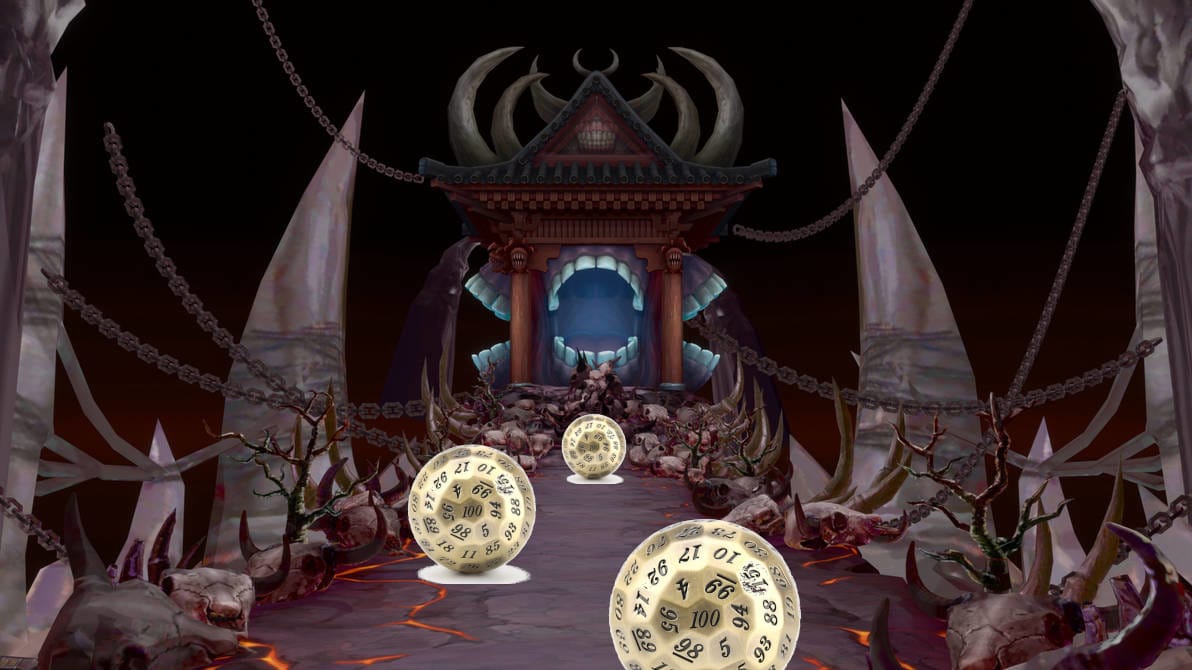
But, why? The number on the dice is just that, a number. Where did YOU get the assumption that a big number was better? Why do I get to enforce the reality that what you rolled was a bad thing actually? Enter the Magic Circle
Defining Boundaries
The concept of the Magic Circle is not a new one, and I presume many of the people reading this at least have a passing knowledge of how it works, but for the uninitiated; The Magic Circle is a game design concept that describes the way objects and actions can take on new meaning depending on the context they are experienced in.
The roll of a dice (a D100) has little intrinsic meaning, but when placed in a specific context (we are playing the RPG Call of Cthulhu) it suddenly determines whether you find the clue, shoot the bad guy, or go insane.
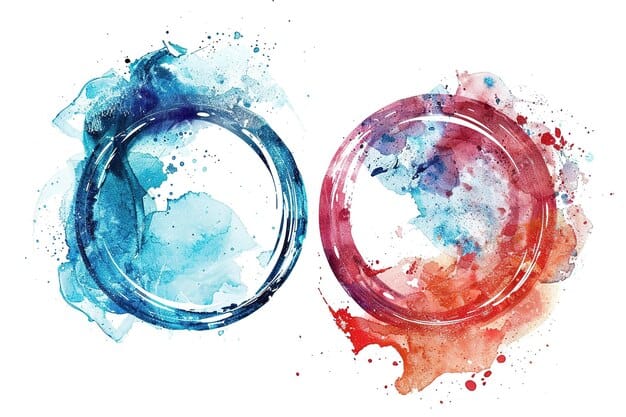
Lets imagine our table on game day. We are sat at it with all of our friends, we've got dice and drinks and whatever paraphernalia is necessary to play the game at hand. Lets draw a red circle around this table in our minds eye.
This is the circle created by the rules of the game we are playing. When the rules are upheld, the red circle grows stronger.
At a fundamental level we can immediately see how this is important. If to be immersed in a game is to be unaware of the game systems you're engaging with, any disruption to the red circle also disrupts our immersion.
Now lets imagine another circle, a blue one concentric with the first. This circle is created by the social dynamic of the group we are playing with.
When we create good memories and uphold our social obligations, the blue circle grows stronger.
I hope I don't have to explain why the blue circle is important, but at this risk of being ridiculed by the chronically online - I believe creating good memories, making friends, and upholding social obligations to be a self evident good.

These circles are rarely entirely independent from one another, and often times our relationship with one effects our relationship with the other. Your theater kid wants to express themselves at the expense of the red circle, your rules lawyer wants to correct other players at the expense of the blue circle, and your GM wants to bail water out of the ship both of you are putting holes in.
Thusly, all problems at the table can be viewed as arising from disagreements on where our red and blue circles lie. Players scuffing them as they tread clumsily around them.
- "You're wrong, that's a Quick Action not a Full Action" (red)
- "I thought the session started at 6 sorry" (blue)
- "I know we agreed to roll for stats but I used the standard array" (red and blue)
- "Please stop talking over me" (blue)
- "Wasn't it my turn next?" (red)
- "Stop telling me how to play my character" (red and blue)
Indeed we could view the job of a GM in its entirety to be tending to the integrity of those all important circles, making sure they are clearly marked to the best of our ability.
In short, when either of the circles are damaged, our game suffers for it.
The Magic Circle was profound when I first read about it years ago but honestly, in retrospect, it's kind of a milquetoast observation.
Its so universal it's almost pointless -
Playing music through my speakers at home is fine. But inside the Magic Circle, it's grounds for whatever the bus version of defenestration is.
Walking around the Magic Circle without any pants on is fine, but outside it's 'indecent exposure'.
I can drink alcohol inside a nightclub, but if I try to drink on the street suddenly its "Please tip your alcohol out sir you can't drink here. This is the fourth time I've told you"
Luckily, a design concept does not gain its value innately. Rather it gains it through its ability to solve problems.
So how do these two circles solve our problems?
Maintaining Integrity
I'm of the opinion that for RPG's, the red circle is generally subservient to the blue. We are using the rules as a scaffold to explore contexts we bring to to the game; If the rules aren't conducive to that, we change them! (It is worth noting here that this is a conceit of modern RPG's and is not universal)
Compare this to a board game where our situation is similar. We are all at a table, snacks in hand, prepared to play a game that only one of us really knows the rules to. The difference with board games is that the game itself provides the context in which the rules are used. The game is telling us how it wants to be played, putting a bigger emphasis on the red circle.
Therefore as GM's, we need to firstly ensure our blue circle remains solid.
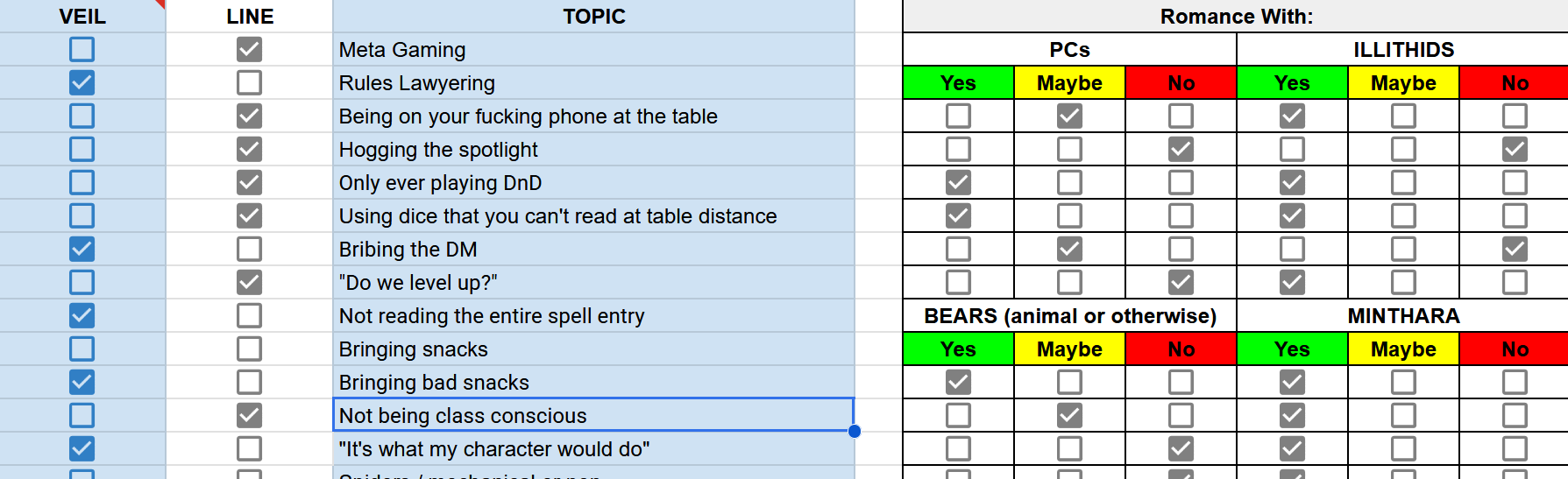
There are plenty of ways to do that, but this soap-box isn't here for me to be the millionth writer to tell you what a Session 0 is or how Lines and Veils work. No, this soap-box is here for me to rant at you about largely non actionable things like: Caring for your Players.
One of my players recently experienced their first character death after ~3 years of playing her.
It was a random stroke of terrible luck; struck by a Beholder's Death Ray for almost maximum damage. Due to a nuance of the narrative, revival is off the table, and we all had to say goodbye to Ellarian the Sea Elf Ranger.
When this happened I stopped the game to put some sad music on, and we talked a bit about the memorable aspects of Ellarian, primarily their shell collection and their remarkable ability to locate the bottom of pits with their face. We had our moment, hugged it out, and play continued.
I did this because I have been party to (and the creator of) too many situations where a player's character is killed, and play simply goes on -
The player with the dead character sits around while the rest of the table continues without them. Everyone else has to sit there awkwardly, going through the motions of pretending everything is totally fine and normal, while acutely aware that there's a ghost both in game and in real life watching them play.
Then the session ends, the red circle around our group dissolves, and there's no levity or excitement for the next session, just an awkward goodbye. A "dm me and I'll help you roll up a new character" if you're lucky.
With the red circle gone we suddenly become aware of how damaged the blue one is. We upheld the integrity of the game, but we failed to uphold our social obligation to see our player as a person with feelings who just lost something they were deeply attached to.
What should've been a memorable, dramatic moment, instead becomes something that we try to move on from without closure. We risk the aggrieved player not returning, and we risk traumatising ourselves against allowing character death in our games.
In Ellarian's example, sacrificing continuity of play allows us to validate her player's feelings, and gives them space to grieve. We sacrifice the integrity of the red circle for the integrity of the blue circle.
But character death is child's play. Just weeks earlier our group faced something far more disruptive, and it came from a source outside of the game.
Two of my players welcomed a baby into the world.
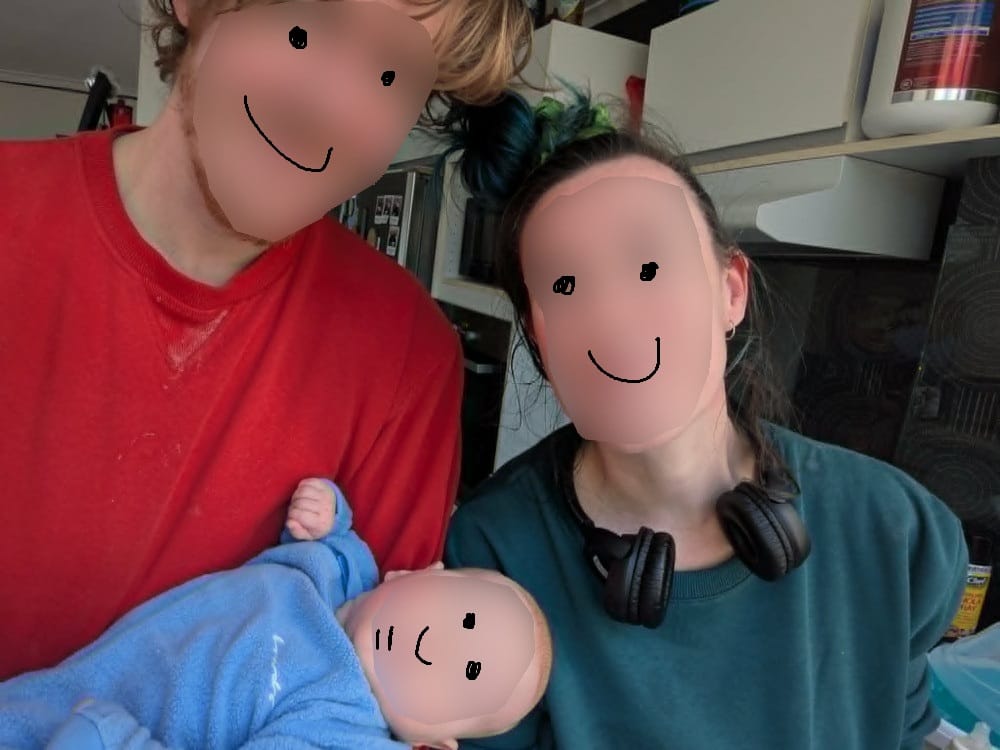
I feel like babies must almost always the swansong for a campaign. Replacing old players with new ones always feel a bit off, especially when the old ones still want to play but can't because of real life obligations (damaging the blue circle), and trying to create narrative and game-play space for new characters is difficult and can feel arbitrary (damaging the red circle).
The new parents were worried in particular about their ability to attend sessions early on in their child's life, and were understandably upset that they may have to give up on a past-time they've been enjoying for almost 4 years.
So what was our response to two players being unable to attend because they made the biggest commitment they will ever make in their lives, and are largely stuck at home for the next 5 years? They now host our sessions! During which we help care for their baby.
It was definitely one of the decisions of all time, but remarkably, it seems to be working. If your take-away so far is "I should invite myself over to my player's house to take care of their child", you have failed.
The point isn't in taking any specific action, it's in listening to what your players say or leave unsaid, and catering for the social needs of your group. It's in preventing the player attrition that arises as our lives and emotions get complicated in small ways (like the death of a character), or in big ways (literal child birth).
It's in protecting that blue circle.
Stranger Things
But what happens if you're running for people who have no real history? Say you've posted on one of the many LFG pages on social media and have found a group of complete strangers, all of various skill levels, ages, and dispositions, all eager to start playing yesterday. Whats the plan?
I guess we'll only really have our red circle to rely on. We have to trust that the game itself is enough to keep people together long enough for us to construct that all important blue circle.
But we'll explore that in a few weeks.
For now, I need to recharge my muse.

Next week. Gain Day - The Gym as the key to the subconscious
Further Reading
- Rules of Play: Game Design Fundamentals. Katie Salen Tekinbas, Eric Zimmerman
- Jerked Around by the Magic Circle - Clearing the Air Ten Years Later. Eric Zimmerman