Herding Cats
The red circle, and building connection between strangers

A few weeks ago in Squaring the Circle we talked about the Magic Circle, and ways we can use it to diagnose the health of our TTRPG's sessions.
In that article we primarily discussed the social element of TTRPG's, and how they form the core of the experience we are having.
We envisioned this as a blue circle around our gaming table.
When we create good memories and uphold our social obligations, the blue circle grows stronger.
We also briefly touched on the concept of a red circle.
This is the circle created by the rules of the game we are playing. When the rules are upheld, the red circle grows stronger.

Both of these circles are concentric around our gaming table, and when both of them erode we get what is frequently described as 'bad vibes'. We risk our session or campaign dissolving as people no longer have a reason to be invested in the experience.
When a group of friends comes together to play a game, we have the benefit of sitting down with a blue circle that is already quiet resilient.
Our history with one another carries over to the table, and even if we don't really get what we are playing or why we are playing it, we are happy to simply find time to spend with friends.
Friend groups are also normally comprised of like-minded people, meaning even if you are all new to the game, you are typically coming at it from a comparable perspective, bringing some form of alignment about the way in which the game 'should' be played.
This means we are also less likely to damage the red circle arguing over how to interpret and apply the games rules.
When we get invested in something, it is natural to want to make sure we get something out of it.
It's the Prisoners Dilemma playing out at our tables.
The Odd Bunch
Now imagine you have literally none of that to fall back on. Instead of everyone being socially invested in the enjoyment of their fellows we have one or more seats at the table taken up by the following.
- Pickled Pete three pints deep who's convinced he's got it all figured out (and is very loud about it)
- A completely disinterested person who's only here because their friend dragged them along
- CR Sam who's watched 300 episodes of Critical Role, owns $600 dollars worth of dice, and has played 0 actual sessions (has a twin called Billy BLeeM)
- Spotlight Steve who understands that there are no friends, only audience members. You're all here to watch all the awesome stuff their character can do
- Ian Inferiority Complex who is convinced that he never rolls above a 10, and will make it his mission to convince everyone hes the most unlucky player at the table. In actuality he rolls averagely because that's what dice do.
- Matt Masters. Thinks he has an encyclopedic knowledge of the rules. Actually has an AI psychosis level of social awareness
And the list goes on.
If any of the players from the events I work at are reading haha dw bro I'm not talking about you.
I am of course exaggerating these behaviours for comedic effect. In reality they will play out in far less pronounced ways, because most people have some level of social humility. Even so, we can't always ignore that voice inside that demands we 'get ours'.
This doesn't make us bad people, it simply makes us human. We are in a situation where we have a choice to take a step back and hope the play time doesn't get hogged by the other players, or to muscle in and make sure we get our piece to the likely detriment of others.
It's the Prisoners Dilemma playing out at our tables.
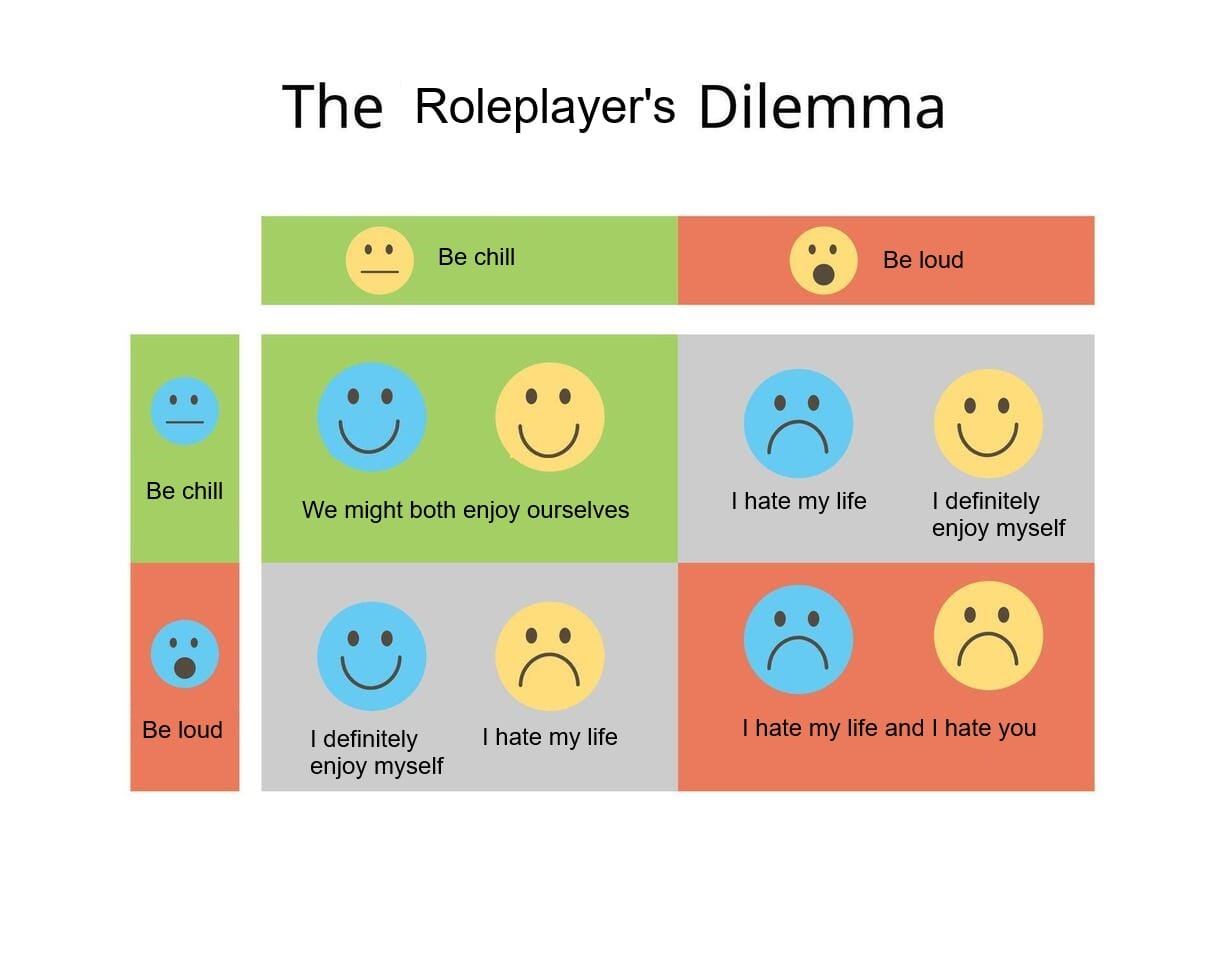
Because there is no social investment to encourage mutually beneficial behaviour, and there is no social consequences for being selfish (at least early on in a campaign or during one-shots), we can justify taking an outsized portion of the fun for ourselves to the detriment of the others players.
So if this is the expected outcome of thrusting a bunch of strangers into an encounter that is complex rules-wise and socially, how do we go about curtailing unwanted behaviour?
There are plenty of tools at our disposal to manage a community, but I'm less interested in what we can do outside the game, and more interested in how we can use the game to build community. This is where the power of the red circle shines
Red Cents
From elected officials, to teachers, to head chefs, to your dad with his strap-toting mistress, everyone loves consensually ceding their volition to authority they view as justified. And what could be more justified than the authority of the thing we all came here to do
Playing the god damn game.
When I sit down at a table with strangers, I find myself tending to rely heavily on a more rules-centric style of GMing. The reason it twofold
Firstly, building the experience around firm enforcement of the systems rules provides a safe neutral ground that all the players have already implicitly agreed to respect by virtue of sitting at the table. It is in this neutral ground that players can get comfortable with one another, and learn how to interact with the world and the other players sharing it.
In comparison, if I throw players into the social deep-end, I risk having the worst aspects of the players react with one another due to the social friction of less structured sessions. First impressions are important, lets help our players make the right ones by easing them in.
Secondly, rules are impersonal. When I say you can't do something because it is not within the scope of the rules, there is an impartiality to the matter that removes myself or any other player from being 'The Authority'.
When I say you can't do something, it is natural to ask me 'why'. When I say that's unfortunately against the rules, we collectively shake our fists at the rules.

But what is this all in service of? If people were interested in playing through a rigorous procedure of rules they would more likely play a board game.
So how do we go about the volatile process of getting these strangers to interact socially rather than systematically? I personally have found no better answer than getting that first big laugh out of the table.
And it can't just be one or two people, it has to be everyone.
There is something magical about sharing a laugh. Laughter is vulnerable, it is intimate, it is an involuntary reaction that shows a little piece of who you are. There is nothing more embarrassing than sharing a joke and nobody laughing, or nobody else laughing along when you find something funny
In indulging in shared laughter, we expose ourselves to this social vulnerability and once we survive it together, our bond grows stronger
Laughter is also a unity of conscious and subconscious in a way that is quite telling to those around you. I believe genuine laughter is comprised of two parts - the recognition of a pattern, and that pattern being subverted in a recognisable but novel way.
When we laugh together, our conscious mind recognises the fact that we all understood the pattern, that we share enough experiences to see through similar eyes.
When we laugh together, our subconscious recognises that we all understand the novel subversion of that pattern in the same way. When prompted to leap, we all leapt in unison.
It's for this reason that when I run D&D and place minis on the table for people to choose from, I also pull out one of my Shadowrun minis - A troll with a minigun.
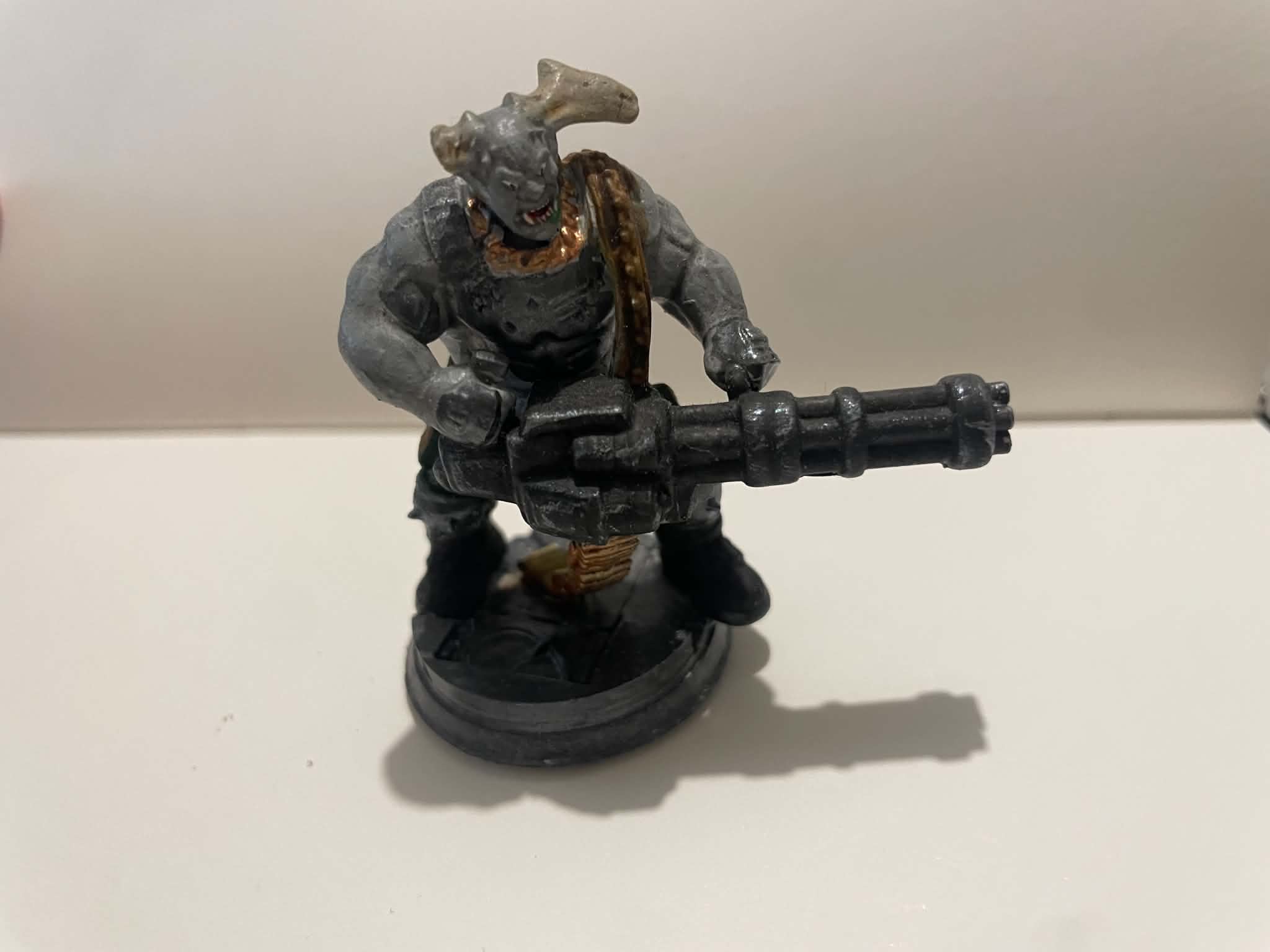
Players are naturally drawn to its incongruity with the rest of the minis on the table and it never fails to provoke someone to pick it up. At that point I get to feign a nonprofessional embarrassment and say "Oh except the troll with the minigun, you cant play him" as I relieve the player of the mini.
I think the 'troll with the minigun' bit works on a few levels.
On the first it is simply a visual oddity amongst the other minis. It draws the eye and gets people curious.
On the second I get to display a little bit of feigned vulnerability and expose a flaw in my until this point professional demeanour. I get to appear more human, and play the clown for players enjoyment. By making myself a part of the joke and laughing, other players feel comfortable laughing along.
On the third, it is a troll with a minigun. It is a unified expression of something that is quintessentially fantasy and expected in a fantasy game (a troll), and something that is quintessentially NOT fantasy and unexpected in a fantasy game (a minigun).
If you're someone who regularly finds yourself running games for groups of strangers, I can't recommend finding a bit to work into your pre-session spiel enough.
If you'd like to steal my bit you're more than welcome to. The stl for the troll can be found here. Just promise you'll think of me when your players laugh (or forget me if they don't, that's all on you bud).
Shades of Blue
So we now have the barest of foundations for our blue circle in the form of a shared joke. How do we go about strengthening it enough that we can begin to loosen our enforcement of the rules, and get to what everyone is actually at the table for?
For me it usually begins before we actually start play.
Together we get to build a bigger, stronger, more inclusive blue circle. Built out of small but powerful memories of 'the cool thing we did'.
As rote as it is, going around the table and getting everyone to introduce themselves a bit helps break that initial ice. It doesn't have to be in depth - Name and/or pronouns, Experience level, How you first learned of the game.
We get the important personal stuff out of the way like how each player wants to be addressed, and provide a small anecdote that has a shared relevance to the situation we find ourselves in.
Next, we get the players to describe what they are doing. Make sure you ask specific players about their character specifically.
DO NOT open by setting the scene with a big description then immediately throwing it to the players with a "So what is everyone doing?". This will not work.
Strangers do not want to risk speaking over one another and will happily sit in awkward silence hoping that someone else takes the reigns in what I can only assume is an expression of the Bystander Effect.
When we see someone break a taboo and survive, it also breaks the taboo in us.
On top of that, as discussed in Muse Juice, there is a social taboo around indulging in creativity and whimsy as a full grown adult. Asking "What is everyone doing?" is like asking a table of virgins what fabric they like on their cuck chairs - they lack the experience, they lack the context, and you're making everyone feel uncomfortable by insisting they answer.
Lets instead start them in the shallow end.
Creativity thrives through constraint, so instead of demanding they swim on their own, give them creative floaties by providing a description, and asking them to fill in a single element of that description.
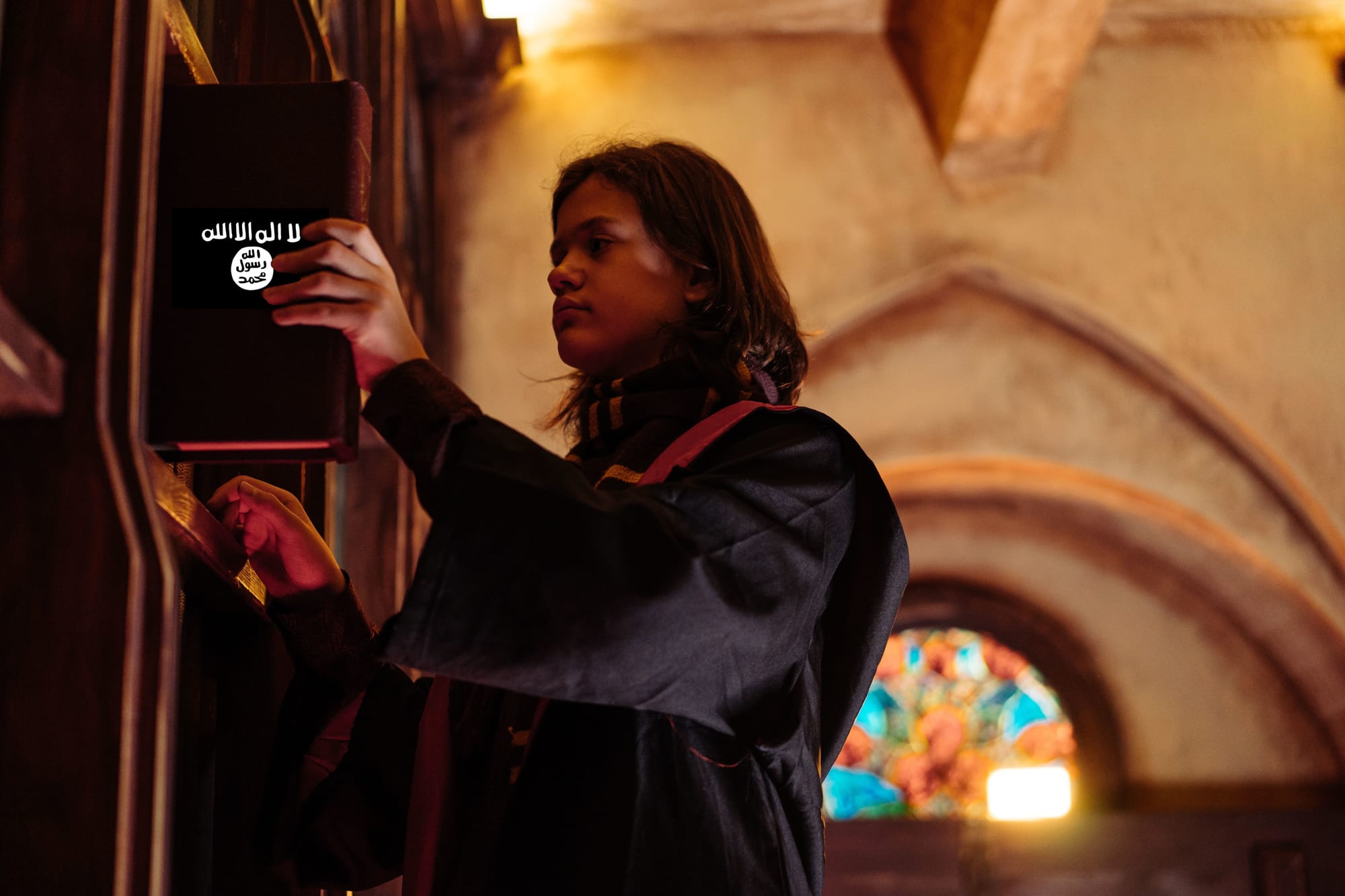
"Your robes are simple but bear the markers of an expertly made garment, much like the book you carry. They are a deep, dark red, and your book is a leather clad tome. Both your robe and book have the same symbol upon them, what is that symbol?"
You're going to get a variety of answers to this question depending on who you ask. Some will ask for additional clarifications before they choose (such as what school their wizard is from), others will say something that has the aesthetic of fantasy while remaining safe and expected, and some will loudly proclaim that their robe has the ISIS logo on it.
For those who are clearly wanting to engage but aren't comfortable doing so, I find that providing them contextual anchor for their answers can help them feel more at ease.
For example. When I ask a player how their spell looks or sounds, I always like to phrase it something like "Normally it sounds/looks like this, but what does YOURS sound/look like?".
Asking this way gives the player a discreet framework to understand their decision through; "You said Magic Missile looks like 3 pale blue darts, mine looks like 3 pale blue unicorns!". It also provides a fall-back in case they cant think of anything
Perhaps in the same way a safety net makes a tight-rope walker feel safe enough to walk, having this default description as a net to catch them helps our players claim their piece of agency over the fantasy we are building.
If we are still having trouble, we can perhaps offer them even more rigorous guidance. At this point I like to begin bringing mechanics into play. If a player can't interact with the fantasy for its own sake, maybe the mechanics can provide the support to do so.
"Well you've been talking a bit and have been persuasive. Maybe your spells are kind of bombastic and visually bright to represent that?"
"You've been stealthed in the shadows a lot, maybe they are kind of quiet and under-sold visually"
"You're an Gnome, so maybe there is that essence of faerie magic in you, and your magic sparkles in pink and purple hues"
It is from these small decisions that the integrity of our blue circle is built. Every single one of these tiny expressions of agency you get the players to indulge in has a compounding effect.
Using the same method we can allow our players to organically grow into the shoes they have come here to fill. We can start asking more broad questions, and leaving more space for our players to create within.
An example of this organic growth might look like...
"So, you all find yourselves in the sparsely decorated guest house of the estate. You've been asked by the majordomo to stay in your rooms for the night and not to wander the halls. Do you all stay in your rooms quietly, or do you do something else?"
We are now finally getting to where we want to be. Our players are in control of the narrative, we no longer need to give them direct examples of what their options are, and we can instead use negative space in our descriptions to fill our player's heads with ideas
"Do you stay in your rooms quietly, or do you do something else?"
What could that something else be? The sentence begs an answer. Hopefully by this point your players feel comfortable enough to provide it. If they do, indulge them, even if the idea is a bit silly.
When we see another player show the vulnerability required to share a silly idea, we gain the confidence to do it ourselves. When we see someone break a taboo and survive, it also breaks the taboo in us.
The hardest part of this process, of course, is always going to be at the start. It is your job to show the players that the unwieldy boulder of TTRPG's can be fun to push.
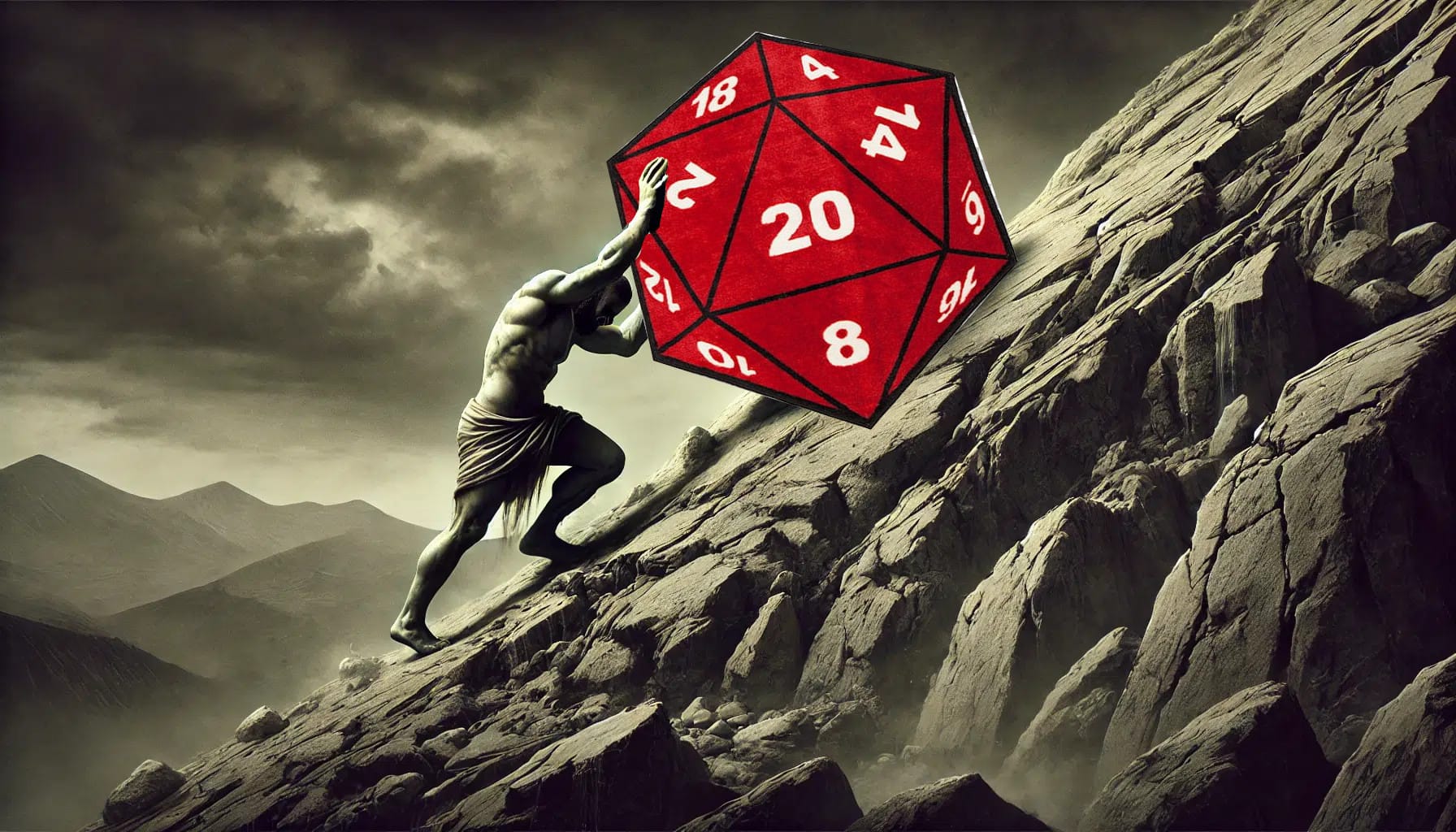
You may sometimes run into players that seem to have no willingness to engage in either the work nor the play at all. I caution against simply accepting that as the reality; if they had no desire to be here and participate, they would not be here.
People deal with social situations differently. When compared to something like basketball, trivia, or drinking at the pub, sitting down at a table with strangers to play through a story using an obtuse set of rules is about as socially demanding as it gets.
Have faith that these players WANT to engage, and regularly provide them the opportunity to do so. Do not linger on them for too long or press them overly hard for answers, let them engage with the game at their own pace.
Although I do believe this is the morally right thing to do, it is also practical. When one player is not engaged with the game, it sticks out like a sore thumb to everyone, and the other players will look to you to help bring that player up to speed.
If you do not make the attempt, everyone simply has to deal with the awkward atmosphere generated through being in proximity to a pariah. You also spoil the sense that we are all here to have fun and that it is alright to ask questions, that we can be a little selfish sometimes in pursuit of us enjoying our time together.
By ignoring a player who's struggling to engage you not only make it clear that they are being a burden, you make the other players feel self conscious about when THEY are being a burden.
Our immersion is disrupted, and suddenly we are reinforcing the taboo we have been working so hard to dissolve.
Finishing Touches
So at this point we are drawing another successful session to a close. If this is the beginning of a campaign, or at a larger event with regular players, it is important that we close up right.
For this, I borrow a technique from my days spent in hospitality. Have you ever wondered why waitstaff seem to be so interested as to whether you enjoyed the food or not? The answer is in the way we form memories.

When we eat food, even if it is good, our brain discards much of the memory for being too similar to all the other times we ate food. When someone asks us directly whether we enjoyed it or not, we are provoked into thinking consciously about our experience.
This reinforces that experience in our minds and forces us to consider it from the perspective of an active participant rather than a passive one
The same can be done post session. While you're packing up, prompt your players with things like "What was the coolest thing your character did?".
When someone gives an answer, don't just hit them with a "Yeah that was cool", find a way to tie another player into it; "Oh man and after she did that, you were able to do such and such". By doing this we shape the memory away from being 'the cool thing I did' into 'the cool thing WE did'.
The next time these players wind up on the same table, they have that shared history with one another, both in-game and out. They will almost be able to do your job for you, inviting each other to indulge in fantasy building, and proving to any newcomers that it is safe for them to do so as well.
Together we get to build a bigger, stronger, more inclusive blue circle. Built out of small but powerful memories of 'the cool thing we did'.
Next week. Lenswork 2: Essential Experience